S
Sharon
Google reviewGreat guy! Nick was the most helpful in my first home buying experience. Very reliable and personable. Highly recommend.
Read Google reviews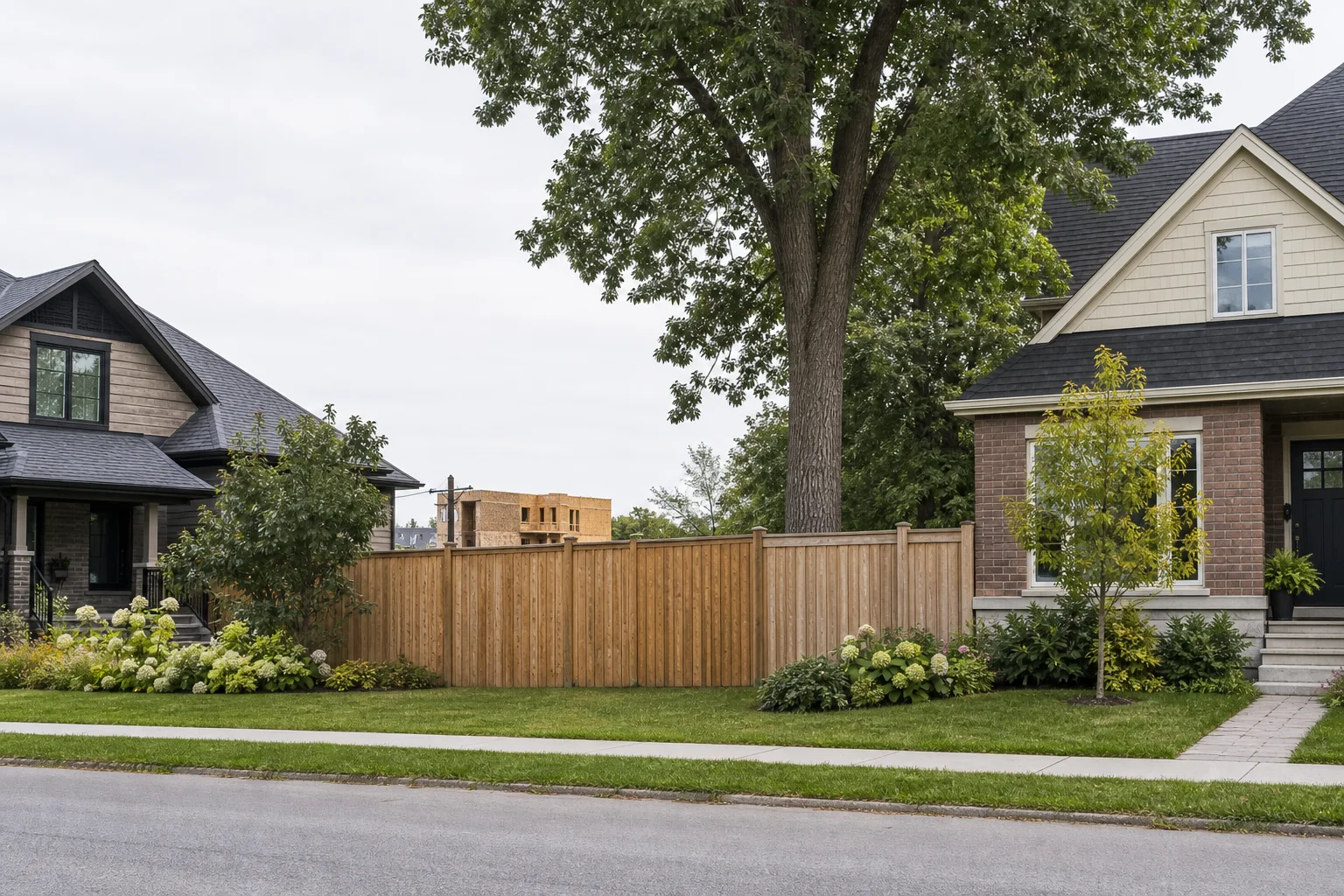
Ottawa property guide · noise, fences, trees and boundaries
By Nick Bachusky, Mortgage Agent Level 1 · Published
An Ottawa bylaw complaint usually starts with a practical question: is this a City issue, a private disagreement, or something that needs legal advice? For noise, fence height, protected trees, long grass, weeds, garbage, and property maintenance, the City may be able to investigate. Boundary ownership, compensation, and orders forcing someone to act often fall outside ordinary by-law enforcement. The same distinction helps when comparing different Ottawa bylaw complaints because the correct route depends on the result you need.
I see the property side of this when I review Ottawa purchases and refinances. A fence that appears to mark a lot line may not follow the legal boundary. Nearby development land can mean years of construction noise. A shed or driveway that crosses a boundary can become a title issue long after everyone has grown used to it.
The short answer: Where it is safe, speak with your neighbour first. Keep a dated record. Identify the rule and file through 311 or My ServiceOttawa. If the City cannot decide the issue, consider mediation, a money claim, or legal advice.
The City of Ottawa’s by-law violation page explains what can be reported online and which matters require a 311 call. This guide brings the main neighbour-dispute routes together, including the mortgage and title questions that are easy to miss.
Most Ottawa neighbour disputes are easier to address when you follow the same four steps in order. An immediate threat, violence, active trespassing, or possible criminal conduct is different. Contact police or emergency services when safety is at risk.
Many disputes begin with different assumptions. Your neighbour may believe the fence follows the boundary. They may not realise how clearly a pool pump carries into your bedroom. A calm, specific conversation gives both sides a chance to fix the issue before positions harden.
Say what happened, when it happened, and what would resolve it. Avoid opening with a threat about court or by-law enforcement. If direct contact feels unsafe, skip this step.
Keep dated photographs, times, duration, recordings where lawful, copies of messages, and the names of witnesses. A short entry written when something happens is more useful than trying to reconstruct three months of events from memory.
Documentation helps a by-law officer understand a recurring pattern. It can also help a mediator, lawyer, insurer, surveyor, or judge if the dispute moves beyond the City. Record facts. Avoid guesses about motive.
The City accepts many reports through a My ServiceOttawa account. Other matters, including fence height, are directed to 311. An officer examines the complaint and may begin with a courtesy warning, although that does not apply to every by-law.
Ottawa says your name, address, and telephone number are kept confidential unless the matter goes to court. If it does, you may need to attend as a witness. That is different from a completely anonymous complaint. The City may need your information to investigate and follow up.
For exterior property complaints, the City’s published process includes assignment to an officer, investigation, inspection, possible warnings or orders, a compliance period, and reinspection. If an owner still does not comply, the City may arrange third-party remediation and apply the cost to the owner. The City’s property-complaint process shows each stage.
By-law enforcement deals with compliance. It does not repair a neighbour relationship, award compensation, establish a disputed boundary, or rewrite a private agreement. Those questions may belong in mediation or civil court.
Community Conflict Resolution Ottawa can help with communication. Ontario’s Small Claims Court can hear eligible claims for money or the return of personal property up to $50,000. A request for an injunction, a mandatory order, or a legal boundary declaration is different and calls for legal advice.
Ottawa Noise By-law No. 2017-255 uses both time restrictions and sound limits. The source of the sound matters, as does the time and where the sound is received. The consolidated Ottawa Noise By-law is the controlling City reference.
Under the Ottawa Noise By-law, power equipment such as chainsaws, powered lawnmowers, leaf blowers, and handheld power tools should not be operated between 9:00 p.m. and 7:00 a.m. where the sound disturbs the neighbourhood. On Saturdays, Sundays, and statutory or public holidays, the morning restriction runs until 9:00 a.m.
Loading or unloading transport trucks, moving vans, and other motor vehicles is restricted between 11:00 p.m. and 7:00 a.m. where it disturbs the peace and comfort of residents. The by-law contains exceptions, so check the live text for the location and activity involved.
A loud party at 3:00 a.m. is not a decibel homework assignment for the person trying to sleep. Report the noise while it is happening so an officer has a chance to observe it.
Sound reproduction devices are subject to a 55 dB(A) limit from 7:00 a.m. to 11:00 p.m. when measured at the affected property or other applicable point described in the by-law. Pool pumps, filtration systems, hot tubs, and water-feature equipment are subject to a 50 dB(A) limit at the point of reception.
In plain language, the point of reception is where the unwanted sound reaches another property or person. A level-based complaint often requires an officer to attend while the equipment is running and take a reading. A video can document timing and character, but it is not a calibrated municipal sound measurement.
The City’s construction and machinery complaint guidance separates equipment with time restrictions from equipment that needs a noise reading.
The rules distinguish general construction from demolition, construction, and infill work in established residential areas.
| Work category | Noise is restricted during these hours |
|---|---|
| General construction and heavy machinery, Monday to Saturday | 10:00 p.m. to 7:00 a.m. |
| General construction and heavy machinery, Sunday and statutory holidays | 10:00 p.m. to 9:00 a.m. |
| Demolition, construction, and infill, Monday to Friday | 8:00 p.m. to 7:00 a.m. |
| Demolition, construction, and infill, Saturday, Sunday, and statutory holidays | 7:00 p.m. to 9:00 a.m. |
The City may grant an exemption for certain construction work. If activity appears to fall inside a restricted period, report the live details and ask whether an exemption applies rather than assuming the work is unlawful.
Fence By-law No. 2003-462 regulates fence height, visibility, materials, condition, and which side faces outward. It does not establish the legal property boundary and does not make one neighbour automatically responsible for half the cost.
Section 6 sets the ordinary residential limits:
| Fence location | Maximum height |
|---|---|
| Front yard | 1 metre |
| Any other residential yard | 2.13 metres, or 213 cm |
| Corner or driveway visibility triangle | 75 cm |
At a driveway, the visibility triangle is formed by measuring two metres along the lot line and the driveway from the point where the driveway meets the lot line beside the street. Corner lots use a separate three-metre measurement along the intersecting lot lines.
Side-yard and rear-yard gates may exceed the ordinary height limit by up to 30 cm. Decorative caps on structural posts may extend up to 15 cm above the limit. The finished side of the fence must face the public street and neighbouring properties. Residential chain-link fencing must be vinyl or powder coated.
The current City property guide confirms the 1 metre and 2.13 metre limits. Always check for site-specific approvals, pool-enclosure rules, easements, or safety requirements before building.
The by-law’s definition of a fence does not include a hedge. That means the fence-height rules are not a general height limit for hedges, bushes, or trees used as natural screening. Other visibility, property standards, or safety rules may still apply.
The Fence By-law also does not decide who must pay for a fence. A neighbour is not automatically required to pay half because someone else wants a new fence.
Ontario’s Line Fences Act provides an arbitration process for certain disputes about constructing, reconstructing, or repairing a fence on a boundary. Fence viewers can allocate responsibility, describe the fence, and issue a binding award, subject to the Act’s appeal process. The Act does not force every owner to build a fence. It also cannot establish the location of a disputed property line.
The process does not let an owner complete the entire job on their own initiative and then use fence viewing to force the neighbour to pay after the fact.
Ottawa has narrowed where its fence-viewer process applies. Under By-law No. 2011-350, it is available only for land in listed zones: O1O, O1P, AG, ME, MR, RU, DR, EP2, and EP3. The City’s Line Fences Act guidance lists those zones and the current application fee. It is not a general route for an ordinary urban or suburban residential lot.
A fence is a poor substitute for a survey. If the location matters, review the deed and any existing survey, then retain an Ontario Land Surveyor where necessary. A fence viewer cannot decide the boundary for you.
Before digging, request utility locates through Ontario One Call at 1-800-400-2255. Homeowners should request the locate at least five business days before digging. The service is free, and obtaining locates is a legal requirement. A locate identifies underground infrastructure. It does not identify the property line.
Ottawa’s Tree Protection By-law No. 2020-340 protects certain trees on private property. Provincial law also applies when the trunk grows across a boundary.
On private urban property of one hectare or less, a distinctive tree is generally a tree with a diameter at breast height of 30 cm or more. The protection was extended to suburban properties on February 1, 2024, when the previous 50 cm threshold was reduced to 30 cm.
On private urban property larger than one hectare, trees with a diameter at breast height of 10 cm or more are protected. Other rules apply to development applications, City trees, and identified growth areas. A permit is required before injuring or removing a protected tree unless an exemption applies.
The City’s current Tree Protection By-law guidance includes the thresholds and a decision tool.
Ontario common law generally permits an owner to prune branches that extend over the property line, but only from their side and without trespassing. That right does not include killing, destabilising, or seriously injuring the tree. Cutting the portion on the neighbour’s land may be trespass.
Tree health and ownership can be complicated. Retain a reputable arborist before major pruning. If the trunk location or legal right is disputed, get a current survey and legal advice before cutting.
Section 10 of Ontario’s Forestry Act says a tree whose trunk grows on the boundary is common property of the adjoining owners. Injuring or destroying it without the other owner’s consent is an offence.
The City also requires a boundary-tree co-owner declaration as part of the permit process. The City declaration form records the co-owner’s consent. Removing a boundary tree without the required consent and permit can create provincial, municipal, and civil exposure.
Check the deed and survey, confirm where the trunk crosses the line, and involve an arborist before the disagreement becomes damage that cannot be reversed.
Property Maintenance By-law No. 2005-208 addresses conditions such as heavy undergrowth, long grass, weeds, refuse, and debris. Property Standards By-law No. 2013-416 covers broader maintenance and repair standards for residential and non-residential property, yards, structures, retaining walls, vacant property, and heritage property.
Start with dated photographs and a record of the condition. Identify the likely breach, then file the appropriate online report or call 311. An officer may inspect, contact the parties, issue a notice or order, set a compliance period, and reinspect.
The Property Standards By-law requires owners to maintain property and eliminate unsafe conditions. The City’s process says continuing non-compliance may lead to a fine or third-party remediation billed to the owner.
Keep correspondence from the City. It shows what was inspected, which rule was considered, and what deadline applies.
The right route depends on the result you need. Use 311 for municipal compliance. Use mediation when communication has stalled but both sides may still reach an agreement. Look at Small Claims Court information for an eligible financial loss. Obtain legal advice when you need an injunction, mandatory order, title determination, or boundary declaration.
Community Conflict Resolution Ottawa, formerly Community Mediation Ottawa, provides mediation, conflict coaching, and facilitation for people in the National Capital Region. The process is confidential, impartial, independent of the courts, and supported by volunteer conflict-resolution practitioners.
No-cost service may be available to people who cannot afford to pay. The organisation does not handle family-law matters, assault, sexual harassment, sexual assault, or substantial commercial disputes. It can screen the issue and explain whether the service fits.
Mediation can address the relationship and help neighbours create a practical agreement. A by-law officer cannot do that.
Ontario Regulation 42/25 increased the Small Claims Court monetary limit from $35,000 to $50,000 on October 1, 2025. The Ontario Superior Court’s Small Claims page explains that the court hears civil claims seeking money or the return of personal property.
A claim for the cost of repairing a fence damaged by a neighbour may fit, depending on the facts and law. A request forcing someone to remove a structure, stop an activity, or accept a boundary is different. Section 101 of Ontario’s Courts of Justice Act places injunctions and mandatory orders within Superior Court jurisdiction. Speak with a lawyer about the right court and remedy for your circumstances.
It can, especially when the disagreement reveals an encroachment or uncertainty about ownership, access, parking, or use. It does not mean every complaint will affect financing. A temporary noise issue and a structure crossing the legal boundary are very different risks.
An encroachment is a structure or improvement that sits wholly or partly across a legal boundary without the required right or agreement. Common examples include a fence, deck, shed, driveway, eave, or retaining wall.
A Surveyor’s Real Property Report locates buildings and structures in relation to the property’s boundaries. Ontario Regulation 216/10 requires a plan and written report and sets out what the report must show. A lawyer’s title search reviews registered interests and instruments. Neither should be replaced by assumptions based on lawns, hedges, online maps, or an old fence.
It may cover some unknown survey, boundary, or encroachment problems, but coverage depends on the actual policy and facts. FSRA’s title-insurance guidance says possible exclusions may include known defects, problems only discovered by a new survey or inspection, and issues not in public records, including unrecorded encroachments.
Known or disclosed disputes, active litigation, and visible or accepted conditions may be excluded under a particular policy. Recent buyers should check their policy and survey before paying for demolition, relocation, or legal work. Ask the closing lawyer or insurer to explain the wording. Do not assume the word “title insurance” settles the claim.
An unresolved boundary issue may delay or complicate a sale or refinance where a buyer, lawyer, insurer, appraiser, or lender needs clarity about title or marketability. Outcomes are file-specific, so I never promise that a lender will accept or reject a particular issue.
For an initial Ottawa budget, these lower planning ranges are useful starting points:
| Material | Starting planning range per linear foot | What current local guides show |
|---|---|---|
| Pressure-treated wood | $25 to $40 | One Ottawa guide supports $25 to $40, while other designs and suppliers quote materially higher ranges |
| Cedar | $35 to $55 | One guide supports $35 to $55, while premium cedar guides extend much higher |
| Vinyl | $40 to $60 | Some local guides extend to roughly $70 to $85 |
| Chain link | $15 to $25 | Entry-level guides support this range, while coated or heavier systems can cost more |
Current local planning guides do not always include the same height, demolition, posts, gates, terrain, hardware, tax, or warranty, so their published ranges differ. Treat the figures above as an early budgeting aid, not a quote.
A 100-foot cedar fence can be a five-figure decision even at the lower planning range. Obtain written quotes that define removal, property-line preparation, materials, posts, gates, finish, permits, locates, tax, and cleanup.
Free download: Ottawa Neighbour Dispute Documentation Checklist. Use it to organise dates, evidence, City contacts, survey details, quotes, and financing questions before the situation becomes harder to untangle.
If the work is significant and you have enough equity, a refinance or home equity line of credit may carry a lower borrowing rate than a credit card or unsecured line. That does not make it automatically cheaper overall.
I compare the mortgage-break penalty, legal and appraisal fees, the new rate, repayment structure, interest over the expected payoff period, and total borrowing cost. A refinance can spread a project over a longer term, which may reduce the payment while increasing the total interest paid.
My rule is simple: “a rate is not just a rate, the penalty matters.” Review the numbers before signing the fence, retaining-wall, drainage, regrading, or tree-removal contract.
Read my guides to mortgage refinancing in Ottawa and mortgage penalties in Ottawa before comparing the financing choices.
| If the problem is… | Start here |
|---|---|
| An immediate threat, violence, active criminal conduct, or urgent safety risk | Police or emergency services |
| Noise, fence height, a protected tree, weeds, long grass, garbage, or an exterior property condition | My ServiceOttawa or 311 |
| A communication breakdown where both neighbours may negotiate | Community Conflict Resolution Ottawa |
| A measurable financial loss within the court’s monetary jurisdiction | Ontario Small Claims Court information and legal advice as needed |
| A disputed boundary, title issue, injunction, or mandatory order | Ontario Land Surveyor and legal advice |
| A major repair that may require borrowing | Written project quotes plus a full borrowing-cost comparison |
This table provides general routing information. It is not legal advice and cannot determine jurisdiction for a particular dispute.
Still wondering?
Ottawa describes by-law complaints as confidential rather than completely anonymous. Unless the matter goes to court, the City says your name, address, and telephone number will be kept confidential. If a prosecution requires your evidence, you may need to attend as a witness. When filing a city of ottawa bylaw complaint, ask the intake agent how your information and evidence may be used.
The ordinary residential maximum is 1 metre in a front yard and 2.13 metres in any other yard. A fence within a corner or driveway visibility triangle cannot exceed 75 cm. Gates and decorative post caps have limited allowances. Pool enclosures, arterials, easements, approvals, and site-specific safety rules can change what applies, so check the live City requirements before building.
No, not automatically. Ottawa’s Fence By-law regulates the fence, not private cost sharing. The Line Fences Act can allocate work and costs in qualifying situations, but Ottawa limits fence viewing to specific listed zones. It cannot establish a disputed boundary, and an owner cannot normally complete the full job unilaterally and then use the process to force payment after the fact.
Ontario common law generally allows pruning back to the property line from your side, provided you do not trespass or seriously injure, destabilise, or kill the tree. A trunk crossing the boundary is common property under section 10 of the Forestry Act. Hire an arborist for significant work and obtain legal advice if ownership, tree health, or the boundary is disputed.
Keep a dated log and report the noise while it is happening so an officer has a chance to observe it. Ottawa provides specific online routes for barking dogs and loud noise or shouting. A 3:00 a.m. party may be investigated as a disturbance. Equipment complaints may require a live sound reading under the Ottawa Noise By-law, depending on whether the rule is time-based or level-based.
It may if the dispute creates uncertainty about title, a boundary, access, parking, use, or resale. A survey, lawyer’s title search, and title-insurance policy can help identify the issue, but coverage and lender treatment are file-specific. Resolve or document material encroachments early. For buyers, review the survey, title policy, and neighbouring development before closing. My first-time home buyer Ottawa guide explains the wider due-diligence and financing process.
Neighbour disputes grow expensive when facts stay unclear. Start with the smallest step that can produce a real answer. Confirm the noise hours. Locate the boundary. Measure the tree. Get the City file number. Put the agreement in writing.
If the issue touches a purchase, sale, refinance, title problem, or a major repair bill, bring the documents into the financing conversation early. I can explain the mortgage side and coordinate with the lawyer, surveyor, insurer, or contractor you choose. I am one WhatsApp message away.
This article provides general information, not legal advice. By-laws and provincial regulations change. Check 311 or ottawa.ca for current City requirements and speak with a lawyer about your circumstances.
Nick Bachusky, Mortgage Agent Level 1, Referral Mortgages Inc., FSRA #13316, Mortgage in Ottawa. Book a conversation.

About the author
I am Nick Bachusky, a Mortgage Agent Level 1 working under Referral Mortgages Inc., FSRA brokerage licence #13316. I have spent 14 years in mortgages, including time at RBC and TD, and I see the property questions that can complicate a purchase or refinance.
I keep the mortgage side clear and coordinate with the lawyer, surveyor, insurer, arborist, or contractor you choose. If you want to discuss how a property issue may affect your financing plan, I am one WhatsApp message away.
Nick Bachusky · Mortgage Agent Level 1 · Referral Mortgages Inc. · FSRA brokerage licence #13316. This article is general information, not legal advice. Confirm current City rules through 311 or ottawa.ca and speak with a lawyer about your circumstances.
Keep reading
A few plain-language guides on buying, refinancing, protecting the home, and keeping the closing process organised.
How I handle the financing, lawyer instructions, closing conditions, and the property questions that need an early answer.
Nick Bachusky August 2026 How I compare the penalty, fees, new rate, repayment plan, and total borrowing cost before you commit.
Nick Bachusky August 2026 What your lender checks, what it does not, and why flood and sewer backup coverage are separate decisions.
Nick Bachusky August 2026 From the first conversation to broker complete, with the lawyer, insurer, and other professionals kept in the loop.
Nick Bachusky August 2026 4.9 stars from 64 Google reviews left by clients I have worked with across Ottawa.
Get in touch
Getting a mortgage does not need to be stressful. Leave your details and I reply within about 30 minutes during business hours.
Bring the survey, notice, estimate, agreement, or lawyer's note. I will explain the financing side clearly and help you understand what needs to be resolved before you commit.
Nick Bachusky · Mortgage Agent Level 1 · Referral Mortgages Inc. · FSRA brokerage licence #13316. Ottawa and the surrounding area.